
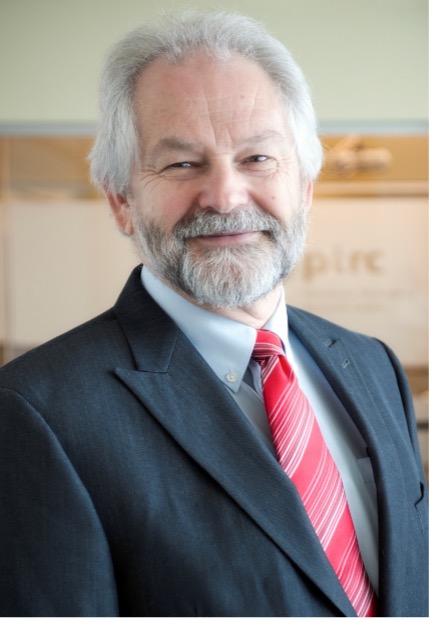
Malcolm received his BSc from the University of Nottingham (1972), and his MSc (1977) and PhD (1981) from the University of Saskatchewan.
Malcolm is now semi-retired, but retains an interest in Carbon Capture and Storage including co-editing two books “Geophysics and Geosequestration” (Cambridge University Press, 2018) and Geophysics and the Energy Transition, (Elsevier 2025).
In 1998, Malcolm played a significant role in the establishment of the Petroleum Technology Research Centre (PTRC) in Regina. After having served on the board, he became the CEO in 2011 and stayed till 2013. He was active (and head of the Canadian delegation) on an ISO committee (ISO TC265) which has developed a number of voluntary standards for CO2 Capture, Transport and Storage.
Malcolm was the Director of the Office of Energy and Environment at the University of Regina from 2000 – 2010, prior to which he worked for Saskatchewan Energy and Mines for twenty years. He was instrumental in the creation of the IEAGHG Weyburn-Midale CO2 Monitoring and Storage Project, a world recognised CO2 storage research project, including editing the final report of phase one. In the fall of 2012, another PTRC project was responsible for an historic event, the drilling of the deepest well in Saskatchewan’s history: 3396 metres. Malcolm was a member of Working Group III of the Intergovernmental Panel on Climate Change (IPCC), the scientific team awarded the 2007 Nobel Peace Prize jointly with Al Gore, and for which Malcolm was a lead author on the IPCC Special Report on Carbon Dioxide Capture and Storage. He is the former Director of the International Test Centre for CO2 Capture (ITC). He also founded the Prairie Adaptation Research Collaborative (PARC), serving as its first head.
For many years, Malcolm was one of two Canadian representatives to the International Energy Agency (IEA) Greenhouse Gas R&D Programme, and he also served as vice-chair of the IEA Enhanced Oil Recovery Implementing Agreement. He was on the science advisory boards of two major European CO2 storage projects, RISCS and CATO-2, a Dutch national program, (both projects have concluded their research work successfully) as well as being a project reviewer for several leading carbon capture and storage programs, including the CO2 Cooperative Research Centre in Australia and the United States Regional Partnership Program. He was an advisor to CO2Sink and CO2GeoNet, former EU programs and until recently was on the Advisory Committee for the Reservoir Characterization Project at Colorado School of Mines. He has organised major international conferences, including the 2004 Greenhouse Gas Control Technology Conference in Vancouver and the International Energy Agency Enhanced Oil Recovery Conference, 2012, in Saskatchewan. In 1991, he initiated the Williston Basin Petroleum Conference, a very successful annual meeting between Saskatchewan and North Dakota. In 2012, it boasted over 4,000 participants.
In 2009, Malcolm was awarded the University of Saskatchewan Alumni Award of Achievement for outstanding contributions to profession, community and the University of Saskatchewan. In the same year, Saskatchewan Business Magazine named him one of Saskatchewan’s ten most influential men. In 2013 he was recognised as one of five influential people in the Province’s oil industry. He was the joint winner of the 2006 Natural Sciences and Engineering Research Council of Canada (NSERC) Synergy Award for his work with ITC.
